
More than 6,000 US women reach the menopause milestone daily, with an average age of onset at 52, according to the Society for Women’s Health Research. Eight to 10 million women experience menopausal symptoms in any given year.
Among the many recorded symptoms, “unfavorable changes in hair” was noted by 72% of women going through menopause, according to the results of The Benchmarking Company’s (TBC) February 2026 primary online consumer study. The 4,000+ respondent study captured pain points and beauty and personal care brand remedies sought from women currently in perimenopause, menopause, or post-menopause[1], with hair issues in particular focus.
Where She Finds Answers
Eighty-seven percent (87%) of women in menopause say they always (50%) or sometimes (37%) experience menopausal symptoms that frustrate them. This percentage is in line with other currently published research about frequency of symptoms, and an increase from TBC’s 2021 study of menopausal women, where that combined rate was just 72%.
To find information that will help her navigate the stages of menopause, her own Internet research (with ChatGPT cited often) now serves as the main source of inspiration for 78% of all menopausal respondents. Her own doctors were her main source of education on the subject as published in TBC’s 2021 study (when doctors were noted at 69% and her own Internet research was 55%). Her doctors (now 58% for women of all stages), friends and family (57%), and what she’s learning from social media sources (21%) are helpful as well. Social media has climbed as a trusted resource since TBC’s 2021 study, when just 9% looked to social media for answers.
| What are/were your main sources of information as you navigate the stages of menopause? Select up to 3. (only those at 10% and higher shown) | ||
| Perimenopausal women | Menopausal women | Postmenopausal women |
| Internet/My own research: 81% | Internet/My own research: 78% | Internet/My own research: 74% |
| Doctor: 54% | Doctor: 62% | Doctor: 60% |
| Friends/Family: 62% | Friends/Family: 60% | Friends/Family: 52% |
| Social Media: 29% | Social Media: 22% | Social Media: 13% |
Sleep, Hair, and Sweat
“Sleep pattern disruption” (77%) is the most cited frustration for women in all stages of menopause, with “unfavorable changes in my hair” close behind at 72%. Hot flashes (67%), unfavorable skin changes (67%) and night sweats (67%) followed. Not surprisingly, those in active menopause noted these frustrations with more frequency than those in perimenopause or post-menopause.
| What menopausal issues or changes have you experienced? Select all that apply. | ||||
| Total | Perimenopause | Menopause | Post-menopause | |
| Sleep pattern disruption | 77% | 75% | 82% | 76% |
| Unfavorable changes in my hair | 72% | 72% | 75% | 70% |
| Hot flashes | 67% | 58% | 81% | 70% |
| Unfavorable changes in my facial or body skin | 67% | 67% | 73% | 65% |
| Night sweats | 67% | 64% | 76% | 64% |
| Difficulty losing weight | 65% | 61% | 68% | 67% |
| Mood swings | 58% | 63% | 65% | 48% |
| Decreased sex drive | 56% | 53% | 60% | 58% |
| Vaginal dryness | 45% | 33% | 56% | 53% |
| Drop in estrogen levels | 38% | 28% | 46% | 44% |
| Irregular periods | 28% | 55% | 19% | 5% |
| Incontinence | 26% | 23% | 29% | 26% |
| Painful sex | 23% | 15% | 28% | 27% |
| Change in vaginal odor | 20% | 22% | 25% | 14% |
| Vaginal atrophy | 12% | 6% | 13% | 19% |
| Favorable changes in my hair | 4% | 5% | 6% | 3% |
| Favorable changes in my facial or body skin | 4% | 5% | 6% | 3% |
Interestingly, “difficulty losing weight” rates lower on the issues menopausal women experience today for each stage, as compared to the 2021 study when that percentage was 73%, compared to 65% on average now. Perhaps the rise in GLP-1 usage has eased that frustration.
Hair Issues, Defined
Of those fortunate menopausal women who say that menopause has caused favorable changes in their hair (just 4%), the most commonly cited change was hair that went from straight to wavy (31%). Other positive hair changes since menopause were hair growing faster (30%), less hair loss/shedding (29%), hair has more body/is fuller (22%), healthier-looking hair (21%), and thinning areas of hair filling out (21%).
The majority of those with changing hair didn’t fair as well.
Hair thinning (77%) and hair loss/shedding (80%) are the top 2 negative hair changes women experience since perimenopause or menopause (up sharply from the 2021 study results, where hair thinning or shedding were negative effects hovered around 50% for menopausal women.) Dry hair (58%), greying hair (57%), and limp hair (50%) round out the list in 2026 for more than half of those experiencing negative hair changes. For those in menopause, 55% also experience hair breakage.
| What are the negative changes in your hair since perimenopause or menopause? Select all that apply. | ||||
| Total | Perimenopause | Menopause | Post-menopause | |
| Hair loss/shedding | 80% | 81% | 82% | 79% |
| Hair thinning | 77% | 77% | 74% | 78% |
| Dry hair/loss of hydration | 58% | 57% | 65% | 56% |
| Greying/whiting hair | 57% | 55% | 57% | 58% |
| Limp/lifeless hair | 50% | 49% | 55% | 50% |
| Hair breakage | 49% | 50% | 55% | 45% |
| Rough/brittle hair texture | 40% | 40% | 45% | 37% |
| Natural color is less vibrant | 30% | 29% | 30% | 30% |
Help and Hope for Menopausal Hair
To combat their hair issues at this life stage, 43% color their hair, 41% use leave-in conditioners, 37% use specialty styling products, 34% have switched to a silk pillow, and 25% use specialty hair treatments or repair products, along with thickening shampoos (25%). Fifteen percent (15%) currently use a non-prescription hair health supplement.
There are many solutions that she’s interested in trying, but she just hasn’t done so yet. Seventy percent (70%) of menopausal women said they’re interested in using an LED hair growth helmet that uses low-level red-light therapy to stimulate hair follicles. Specialty scalp treatments (65%), anti-grey boosters or supplements (64%), densifying shampoos (64%), specialty bristle brushes (63%), and keratin treatments (63%) are also of strong interest.
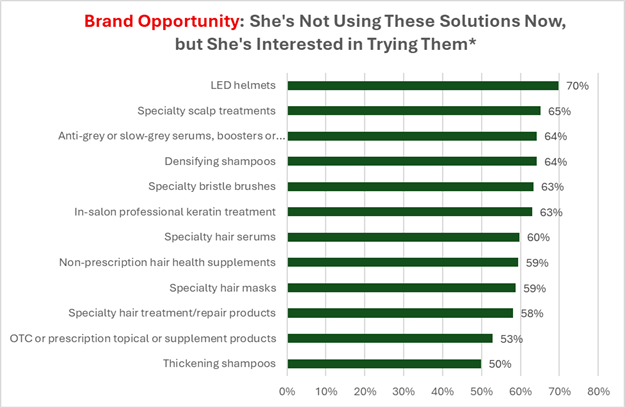
*Interest levels at 50% and higher shown
More than a third (36%) of menopausal women believe hair products specifically marketed as “for those experiencing menopausal symptoms” work better than hair products marketed to the general public (60% say they work the same).
Those who believe they work better say so because the products are specifically formulated for women in their life stage (92%), they’ve got proof of efficacy behind them in the form of product reviews and consumer claims (60%), show clinical test results (48%), and have ingredients that are known problem-solvers (47%).
They’ve used brands that market their hair products for menopausal women, such as:
- 34% – Olaplex
- 32% – Nexxus
- 25% – Kerastase
- 22% – Living Proof
- 19% – Color Wow
- 15% – Nutrafol
- 13% – Rogaine
- 10% – Biogeo
Other brands used now or in the past for menopausal hair issues cited were Hers (9%), BondiBoost (7%), Fekkai (7%), Vegamour (4%), Better Not Younger (4%), and many others.
Hair Longevity – The Bigger Picture
Just 14% of women in menopause (and 26% of younger women) have heard of the growing wellness trend of “hair longevity.” This was described to respondents as focusing on maintaining scalp, hair follicle, and strand health to prevent premature aging, breakage, and density loss. Rather than just “anti-aging,” it prioritizes a long-term “health-span” for hair through a holistic approach. This is often a “cocktail” of products approach, including topical treatments, nutritional support, and in-salon care, rather than relying on a single product.
Eighty-two percent (82%) of all women find the concept of hair longevity to be appealing, with 78% believing that employing a hair longevity approach to hair care will result in healthier hair for longer.
Aspects of this approach that all respondents found most appealing include:
- 82% – moving beyond just “quick fix” regrowth by keeping follicles younger for longer, focusing on density, thickness, and a healthy growth cycle.
- 81% – using products with peptides, antioxidants, ceramides, and probiotics to protect against UV rays, pollution and damage.
- 79% – that this trend is more “prevention first”, instead of treating damage that has already occurred.
[call out] She Needs Proof: 77% need proof of efficacy in the form of product reviews, consumer claims, or clinical testing to adopt a hair longevity regimen.
Most women don’t currently use a hair longevity approach to their own hair—just 14% of women overall (with 21% of those still in child-bearing years)—but there is strong interest. Eighty-two percent (82%) of all women (76% of those not yet in perimenopause) are interested in doing so.
There are some caveats to her acceptance of the concept. First, she’ll need to be able to afford a hair longevity regimen, according to 85% of all respondents. Importantly, 77% say they’ll need proof of efficacy in the form of product reviews, consumer claims, or clinical testing to influence her to adopt a hair longevity regimen. Seventy-two percent (72%) say the products would need to be easily incorporated into her hair care regimen, and 46% want the regimen to be tailored to her life stage.
With 60% of all women already using 3-4 hair care products in their regular regimen (18% use 5 or more products), it may be a matter of brands offering education to inform buyers of the best product mix to achieve healthy hair through this holistic approach—as well as proof of efficacy. This could be a boon to future menopausal women who might not suffer the same hair issues through those life stages.
[1] Menopausal stages were defined at the beginning of the study to respondents as: Perimenopause: menstrual cycle becomes irregular, but it hasn’t stopped; Menopause: when you have your final menstrual period and have gone a year without one; Post-menopause: begins one year from final period.
Click here to read the full story at GCI Magazine: https://gcimagazine.texterity.com/gcimagazine/library/page/april_2026/36/?oly_enc_id=5245D4892912J0Y