
How inclusive do consumers believe brands are when it comes to representing them through a diverse array of complexion shades and color offerings? If she can’t find her perfect hue, does she ask for help in-store, mix shades, or just give up? And is it only the deeper tones with this difficulty, or does a percentage of every skin tone have a pet peeve when it comes to finding her true colors? In March 2026, The Benchmarking Company asked more than 4,300 US females their thoughts on this purchase dilemma, and what they’d like to see from your brand next.
Inclusivity Matters
- 22% agree that beauty brands are genuinely inclusive while 69% state “some are, and some are not”
- 61% of participants with darker skin tones and 39% of participants overall state they have abandoned a specific brand because they felt the brand’s shade line-up was not inclusive
- 25% of all respondents feel that brands do not understand the needs of people with their skin tone while 48% of respondents with darker skin tones (MST 6-10) feel brands miss the mark
Improving Inclusivity: Monk Scale or Fitzpatrick Scale?
Established in 1975, the Fitzpatrick scale categorizes skin tones from light to dark using a six-point scale to measure sensitivity to the sun. Representation of variation in darker skin tones is minimal. Recognizing the lack of inclusivity, Dr. Ellis Monk, in collaboration with Google, created the Monk Skin Tone (MST) scale featuring 10 shades, four of which are for lighter skin and 6 for darker skin tones.
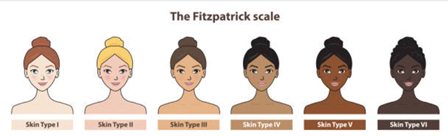
Monk Scale
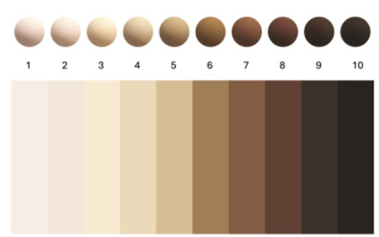
By Comparison
- 17% self-identified their skin tone as a Fitzpatrick type 4, 5 or 6
- 25% self-identified their skin tone as a Monk Skin Tone type 5, 6, 7, 8, 9 or 10
| Ethnicity | Fitzpatrick Scale 4, 5 & 6 (17% of survey respondents) | Monk Scale 5-10 (25% of survey respondents) |
| African American/Black | 39% | 29% |
| Hispanic or Latin American | 8% | 13% |
| Asian | 9% | 11% |
| Mixed Ethnicity | 10% | 10% |
| Hawaiian or Pacific Islander or Alaskan Native and/or Native American | 2% | 2% |
| North African/Middle Eastern | 0.4% | 1% |
What Does an Inclusive Shade Range Mean?
- 78% wide depth range from very light to very deep
- 59% multiple undertone options
- 47% balanced shade distribution between light/dark
- 47% shade testing on real diverse skin tones BRAND OPPORTUNITY
- 46% inclusivity across all complexion categories/products
Regardless of Skin Tone, Shade Match is a Point of Frustration
Consumers find it somewhat to very difficult to find their perfect match
- 41% facial complexion products (56% MST 6-10)
- 38% self-tanner
- 38% body makeup (44% MST 6-10)
- 19% lip color (20% MST 6-10)
- 10% eye shadow (14% MST 6-10)
COMPLEXION
9 out of 10 respondents use facial complexion products regularly
- 78% liquid foundation
- 78% concealer
- 59% setting powder
- 56% bronzer
- 52% tinted moisturizer
- 47% powder foundation
On the Hunt! How She Finds Her Shade
- 66% trial and error purchasing
- 59% in-store shade matching
- 40% online shade finder quiz
- 38% I guess based on the description
Those with MST 6-7/MST 8-10 are 32%/16% more likely to find her shade through in-store-shade matching than those with MST 1-3
Great Expectations
She Expects 16-30+ Shades of Complexion Products
- 61% MST 8-10 agree
- 62% MST 6-7 agree
- 46% MST 4-5 agree
- 51% MST 1-3 agree
Not Quite Right: Why Shade Matching Falls Short
- 66% wrong undertone
- 52% too light (all participants) /62% (MST (6-10)
- 51% shade looks different in photos vs. real life
- 55% too dark
- 34% oxidizes after application (all participants) /39% (MST 6-10)
- 20% limited options for my undertone (all participants)/43% (MST 6-10)
Deeper Shades Mix More
Have mixed 2+ shades together to achieve their match:
- 61% MST 1-3
- 69% MST 4-5
- 79% MST 6-7
- 72% MST 8-10
Changing Seasons Bring Shade Switches
- 80% change her complexion shade seasonally
- 71% buy another shade to manage seasonal change
- 53% mix shades to match changing skin tone
- 47% will use a bronzer/lightener
Why She Mixes Shades
| All | MST 1-3 | MST 4-5 | MST 6-7 | MST 8-10 | |
| My skin tone changes seasonally (i.e. tan in the summer, paler in the winter) | 70% | 66% | 75% | 71% | 54% |
| To customize coverage | 44% | 45% | 44% | 42% | 50% |
| Undertone mismatch | 42% | 41% | 39% | 53% | 57% |
| My perfect shade does not exist | 31% | 29% | 30% | 39% | 46% |
| One shade is too flat | 23% | 22% | 23% | 29% | 28% |
Dark (MST 6-7) and Deep (MST 8-10) Buyers Believe…
- 71% (MST 6-7)/75% (MST 8-10) Beauty brands offer too few deep shades overall
- 77%/67% Deep shades jump too far apart to adequately match my skin tone
- 77%/83% Complexion products for darker skin have limited undertone variety in deeper shades (often only red or neutral)
- 77%/78% Brands often launch with many shades but very few deep options
- 69%/84% There is often a lack of representation of people with my skin tone in beauty marketing
- 82%/86% Shade names sometimes don’t resonate with darker skin consumers, for example calling a beige concealer “nude”
85% of complexion buyers in the MST 6-10 range agree that beauty brands should conduct product testing on women with darker skin (BRAND OPPORTUNITY)
Match–Intelligent Innovations She’s Interested In
- 90% would be likely to try a product that offers customized shade matching
- 60% adaptive pigments that adjust to skin tones
- 58% shade guarantees with easy exchanges
- 55% brands offering custom-mixed foundation
- 54% adaptive formulas that adjust to changes in skin type, i.e. dry in the winter, oilier with hormone surges
- 46% at-home shade scanning devices
- 40% AI-driven undertone detection
- 26% seasonal shade subscription programs
Complexion Brands Doing the Best Job at Shade Range Inclusivity
- 30% Fenty (overall participants) /56% (MST 6-10)
- 29% MAC (overall participants) /35% (MST 6-10)
- 28% Maybelline (overall participants) /23% (MST 6-10)